
The Living Architecture of the Parkland Fairway
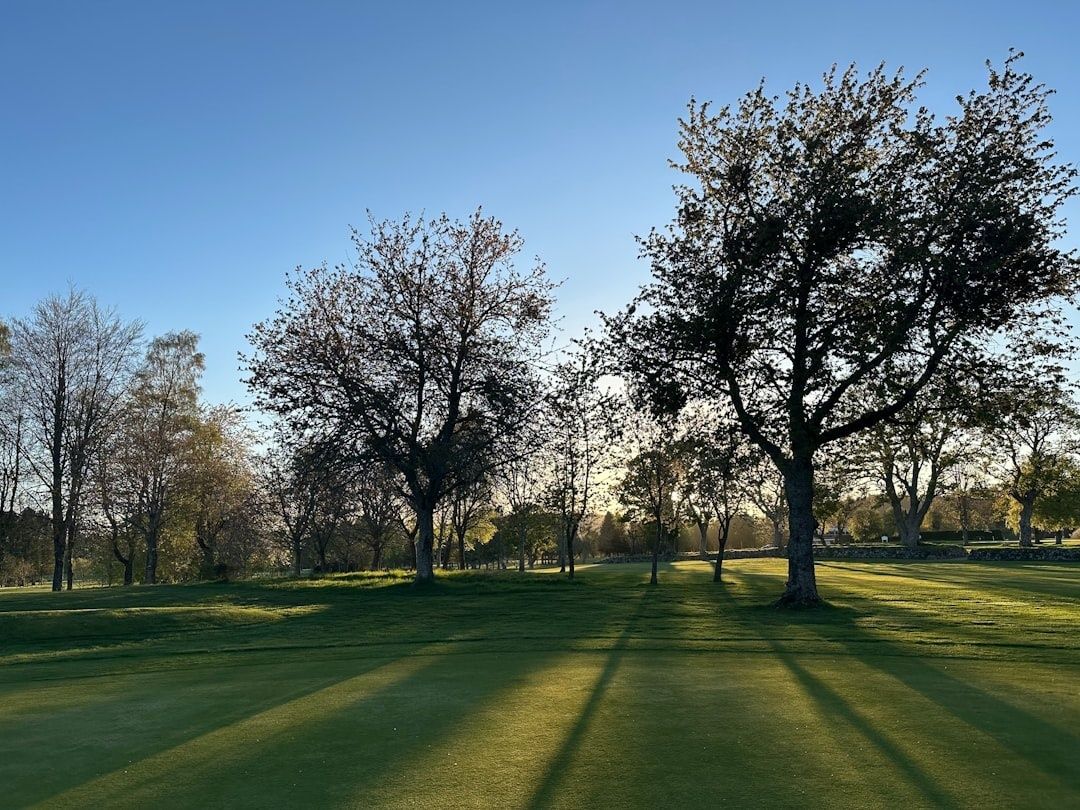
For members, visitors, and guests arriving at a mature inland parkland course, the first impression is often one of calm: generous green space, established avenues, broad lawns, and specimen trees standing confidently above the fairways. Yet this landscape is not simply a manicured setting for golf. It is a carefully evolved architectural composition in which ground contours, woodland edges, grass corridors, and individual trees combine to shape every decision from the tee.
Mature trees are especially important because they turn a flat-looking hole into a three-dimensional puzzle. A trunk can narrow the usable landing area, while a low branch can remove the most obvious approach. A canopy may appear distant from the fairway but still reach across the line of play, forcing a choice between a conservative recovery and a bold shot shaped beneath, around, or over the natural obstacle. In this way, the living landscape defends par without relying solely on length, and it preserves the traditional craft of reading angles, selecting clubs, and committing to a precise line.
Specimen Timber as Strategic Defense Against Pure Distance
Modern equipment has made it easier to launch the ball higher, carry it farther, and attack areas of a course that once demanded restraint. Mature parkland trees provide a durable answer to that extra distance. A tight dogleg framed by hardwoods may offer a tempting opportunity to shorten the hole, but the apparent advantage can disappear when the driver finishes behind an overhanging limb. The golfer may have gained yardage yet lost the approach window, leaving a low punch, a sideways escape, or a difficult attempt to curve the ball through a narrow opening.
This is why tree strategy is not measured simply by counting trunks or judging the width of a woodland. The most influential specimens are often positioned at decision points. One tree protects the inside of a bend, another guards the preferred side of a fairway, and a third screens the corner of a green from an overly ambitious line. Their value lies in placement and height. A broad canopy can penalise a high-launching shot, while a low branch can make a controlled runner more attractive than a full aerial approach. The result is a form of defence that rewards thought before power.
The principles reflect the work of classic architects who used natural elevation, existing vegetation, and risk-and-reward routing to create variety. The strategic tradition associated with architects such as Harry Colt brought links-style decision-making into inland and parkland settings, where positioning mattered as much as distance. Traditional inland communities such as Ballyhaunis have developed vibrant golf clubs within this broader landscape culture, showing how local geography can shape the character of everyday club golf. The town itself provides useful context through Ballyhaunis history and setting, where the surrounding inland environment helps explain why golf in such communities is closely connected to place, participation, and long-standing local identity.
- Before choosing a club: identify the tree that controls the next shot, not merely the tree that looks closest.
- From the tee: favour the side that leaves a clear approach, even when it gives up a few metres.
- When blocked: judge the height and depth of the canopy before attempting a heroic recovery.
- For visitors: allow an extra moment on unfamiliar holes to study how the trees alter the intended line.
Angles of Attack and the Art of the Approach Window
Parkland strategy frequently rewards the side of the fairway that appears less generous from the tee. The wider half may seem to offer greater security, but it can place the ball behind the outer reach of a mature canopy. From there, the golfer may be standing in a comfortable lie with no comfortable shot. The narrower side, by contrast, might open the face of the green, reveal a useful bail-out area, or provide a direct line to the safest section of the putting surface.
The vertical dimension makes these decisions more demanding. A high approach may be impossible beneath spreading branches, yet a low punch must have enough room to land and release. A running shot can be effective when the ground is receptive, but it requires confidence in the contours beyond the first bounce. On other holes, a controlled fade over or around the outer edge of a century-old oak or beech may provide the only route to a tucked pin. Such shots are not merely tests of technique. They are consequences of the position selected one stroke earlier.
A useful way to understand shot value is to compare two imaginary outcomes after a tee shot. From the wide side, the golfer may have 140 metres remaining but only a low channel beneath the branches, with a bunker or steep run-off waiting beyond the green. From the preferred side, the approach may be 155 metres, yet the full putting surface is visible and the ball can be launched normally. The longer approach is often the better result because it offers more options and a larger margin for error. Parkland golf therefore asks not only, “How far is the green?” but also, “How many useful shots remain from here?”
| Fairway position | Immediate advantage | Likely strategic cost |
|---|---|---|
| Wide side near the canopy | More room from the tee | Blocked or restricted approach window |
| Tight side away from trees | Clearer view and fuller shot selection | Greater demand for tee-shot accuracy |
| Inside a dogleg | Shorter route to the green | Branches, trunks, and reduced recovery space |
| Outside a dogleg | Longer route with more visibility | Additional approach distance |
Reviews of Irish parkland courses regularly illustrate this relationship between scenery, routing, and decision-making. At Concra Wood, for example, a water-lined dogleg and narrow green are described as rewarding caution, while the course”s strongest holes demand careful choices as much as confident ball striking. The lesson applies across mature inland layouts: visual drama may attract the eye, but the best score usually comes from identifying the safest angle before reaching for the most powerful club.
Symbiosis Between Root Systems Bunkering and Putting Surfaces
Mature trees do not exist separately from the rest of the course. Their root systems, shade patterns, and canopy spread influence turf health, bunker placement, mowing routes, and the pace at which greens can be maintained. Course management must therefore balance heritage with practical agronomy. Selective arboriculture may involve removing unsafe or declining trees, lifting lower branches, reducing encroachment, or planting successors, but indiscriminate clearance can destroy the strategic framework that gives a hole its identity.
Bunker and green restoration can support this balance when it responds to the established tree lines rather than attempting to overpower them. At Naas Golf Club, a project based on a 2014 masterplan designed by Paul O’Brien of (re)GOLF Design and constructed with DAR Golf Construction introduced a more classical grass-down bunker style, created three new greens, and modified seven existing greens. The work reduced the course-wide sand footprint from roughly 6,098 square metres to approximately 2,806 square metres, while revetted, layered fescue turf produced steeper bunker faces suited to a traditional Irish parkland character. The Bunker and green renovation work reaches completion at Naas Golf Club case study, detailed by the European Institute of Golf Course Architects (EIGCA), illustrates how sympathetic design and construction can restore classical playing lines without disturbing the surrounding canopy.
That example shows how restoration can refine difficulty instead of simply adding it. A bunker can regain a clear visual edge, a green can recover a more classical shape, and the surrounding tree corridor can remain the defining frame. At the same time, shade must be monitored carefully because dense canopy can reduce sunlight and air movement, weaken turf, and prolong surface moisture. Good management may require crown lifting, selective thinning, improved drainage, or the careful selection of grass varieties. The objective is not to freeze a course at one historical moment, but to preserve its strategic language while keeping playing surfaces healthy and reliable.
- Protect the green setting: assess whether tree growth is reducing light, airflow, or turf resilience.
- Restore with restraint: reshape bunkers and greens so that they clarify the original challenge rather than create unrelated hazards.
- Plan succession: establish younger trees before mature specimens decline, while avoiding future over-concentration around playing corridors.
- Communicate changes: explain tree work and restoration decisions clearly to members, visitors, and event organisers.
Preserving Heritage Canopies for the Next Generation of Club Golf
The heritage of a parkland club is often visible in its trees before it appears in any archive. Mature avenues and isolated specimens can suggest the former geometry of an estate, recalling the grand landscaped grounds that shaped many inland courses. Places such as Emo Court and Estate demonstrate how historic architecture, woodland, open parkland, and visitor experience can exist as one connected landscape. Golf clubs inherit a related responsibility: to maintain a setting in which play, community memory, and landscape character reinforce one another.
Club history is also a story of adaptation. Kinsale Golf Club, for example, traces its origins to the 1880s, moved between sites, and eventually developed its championship parkland course at Farrangalway after securing new land in the 1990s. Such histories show that heritage is not limited to a single clubhouse or an old photograph. It includes the decisions that allow a club to remain active, welcoming, and strategically coherent as membership, equipment, weather, and expectations change.
- Record the existing canopy: map important trees, woodland edges, views, and corridors that influence play.
- Assess risk and health: use qualified arboricultural advice to distinguish valuable mature specimens from unsafe or declining growth.
- Plant for succession: introduce suitable young trees early enough to preserve future structure without closing fairways or restricting essential light.
- Coordinate with course planning: align tree work with bunker, green, drainage, and maintenance projects so that each investment supports the whole layout.
- Invite member understanding: explain why a tree is retained, pruned, removed, or replaced, particularly when the decision affects a familiar hole.
For committees, this is a practical form of stewardship as well as a heritage duty. A strategically important tree may take decades to mature, and a careless removal can alter a hole immediately. Conversely, thoughtful succession planting gives future golfers the same sense of place that current members enjoy today. Architectural integrity should therefore be treated as a core club asset, alongside course condition, hospitality, and competitive opportunity.
Step Onto the First Tee with Fresh Strategic Eyes
Once mature trees are recognised as active architectural elements, every round gains another layer of interest. The tee shot becomes a decision about the next window, not just the current distance. The approach becomes a study of height, release, and available recovery space. Even a familiar hole can reveal a new question when the seasons change, a pin moves, or the golfer chooses a different side of the fairway.
Before teeing off, take a moment to survey the corridor ahead. Identify the tree that governs the hole, the side that opens the green, and the recovery option that remains if the preferred line is missed. After the round, the clubhouse terrace offers a fitting place to look back across the course and appreciate the living history framed along its fairways. Those canopies are guardians of more than par. They protect the character, memory, and thoughtful rhythm of traditional parkland golf for every generation still to come.

